

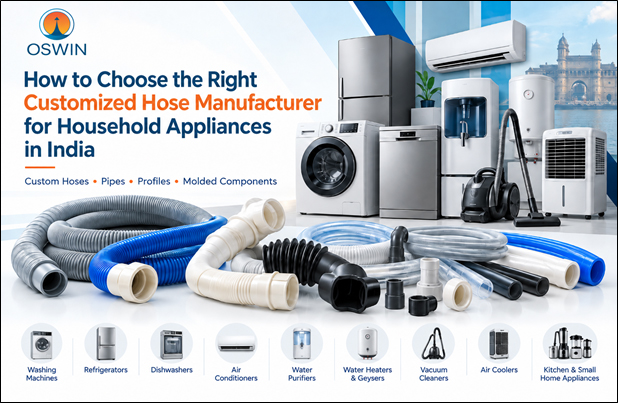
How to Choose the Right Customized Hose Manufacturer for Household Appliances
Choosing the right customized hose manufacturer for household appliances requires more than comparing price per piece. Appliance OEMs should evaluate material compatibility, dimensions, flexibility, pressure and temperature requirements, connection design, production capacity, quality systems, customization capability, and regulatory requirements. A manufacturer with in-house extrusion, corrugation, molding and tooling capabilities can provide better control from prototype to production.
Why Is Choosing the Right Customized Hose Manufacturer Important for Household Appliances?
A hose may appear to be a small component, but it can directly affect an appliance’s water flow, drainage, flexibility, installation, durability and overall reliability.
For household appliance manufacturers, the correct hose must work within the appliances actual operating conditions rather than simply matching a nominal diameter.
A customized appliance hose is a flexible or semi-flexible polymer tube, pipe, bellows or hose manufactured according to the appliance manufacturer’s specified dimensions, material, geometry, connection requirements and performance conditions.
- Washing machines
- Refrigerators
- Dishwashers
- Air conditioners
- Water purifiers
- Water heaters and geysers
- Vacuum cleaners
- Air coolers
- Kitchen appliances
- Microwave ovens
- Coffee machines
- Home laundry appliances
- Small home appliances
- Household appliance OEMs
- Consumer durable products
India’s household-appliance sector is also becoming increasingly important for component manufacturers. IBEF reports that India’s household appliances market was valued at approximately ₹1.98 lakh crore in 2024 and is projected to reach about ₹3.03 lakh crore by 2030. The same source reports strong recent demand for refrigerators, washing machines and air conditioners.
The key takeaway: appliance OEMs should select a hose manufacturer based on engineering capability, consistency and application knowledge; not only the lowest quotation.
What Should You Check Before Selecting an Appliance Hose Manufacturer?
Before finalising a supplier, evaluate the manufacturer across eight important areas:
| Evaluation area | What to check |
|---|---|
| Application knowledge | Experience with household appliances and consumer durables |
| Material selection | Polymer suitability for water, temperature, chemicals and environment |
| Dimensional control | OD, ID, wall thickness, length and tolerances |
| Product design | Corrugation, bends, bellows, profiles, adapters and connection geometry |
| Manufacturing capability | Extrusion, corrugation, blow molding, injection molding and over molding |
| Customization | Ability to manufacture according to drawings and samples |
| Quality | Inspection, testing and batch consistency |
| Production capacity | Ability to support prototype, pilot and mass-production requirements |
A reliable supplier should also be able to discuss why a particular material or construction is appropriate for the application, rather than simply accepting a drawing and producing it.
Which Types of Hoses Are Used in Household Appliances?
Different appliances require different hose designs because their operating environments are not identical.
Washing Machine Hoses
Washing machines commonly require:
- Water inlet hoses
- Drain hoses
- Internal drain hoses
- Overflow hoses
- Shower hoses
- Front-load inlet pipes
- Top-load inlet pipes
- Inlet pipe extensions
- Internal body-to-drum hoses
- Bellows and flexible connections
Washing machine hoses need to accommodate movement, bending, water exposure and repeated operating cycles.
For example, a drain hose may need flexibility to accommodate installation routing, while an internal hose may require a specific bend radius and connection geometry.
Refrigerator Hoses and Pipes
Refrigerators can require:
- Internal pipes
- Drain tubes
- Water-related tubing
- Internal profiles
- Glass shelf profiles
- Door-related profiles
- Commercial refrigerator pipes
The correct component depends on the refrigerator design and its specific fluid-routing or structural requirement.
Dishwasher Hoses
Dishwashers commonly use:
- Inlet hoses
- Drain hoses
- Internal pipes
- Flexible connections
Because dishwashers operate with water, detergents and elevated temperatures, the hose material and construction should be selected according to the actual application conditions.
Air Conditioner Hoses
Air-conditioning systems may require flexible drainage components such as:
- AC drain hoses
- Drain hoses
- Internal pipes
Water Purifier Pipes
- Water inlet
- Filter connections
- Internal water routing
- Drainage
- External connections
Material selection becomes particularly important where the tube comes into contact with water intended for household use. OEMs should define the applicable material and regulatory requirements for the intended application.
Vacuum Cleaner Hoses
- Repeated bending
- Flexing
- Airflow
- Negative pressure or suction
- Mechanical handling
- Abrasion
Air Cooler Pipes
How Do You Choose the Correct Material for an Appliance Hose?
Material selection should begin with the application’s operating conditions.
Common polymers used for appliance hoses and related components include:
- LLDPE – often used where flexibility and suitable chemical resistance are required.
- LDPE – commonly considered for flexible tubing applications.
- HDPE – useful where greater rigidity and durability are required.
- EVA – can provide flexibility for selected applications.
- PVC – widely used for various rigid and flexible pipe applications.
- PP – useful where temperature and chemical resistance requirements make polypropylene appropriate.
- ABS – commonly used for rigid components and profiles.
- TPE – useful where flexible, molded or over-molded components are required.
The correct polymer cannot be selected from the appliance name alone.
For example, a washing-machine hose carrying water and a vacuum-cleaner hose carrying air have different functional requirements.
The manufacturer should evaluate:
- Fluid or air being transported
- Operating temperature
- Pressure or vacuum
- Required flexibility
- Chemical exposure
- UV/environmental exposure
- Required service life
- Connection method
- Appliance installation space
- Applicable regulatory requirements
Its household-appliance corrugated hoses can use LLDPE, LDPE, HDPE and EVA, while its extrusion capabilities include PVC, LDPE, HDPE, PP and ABS, depending on the product/application.
Key statement: The correct hose material is determined by the application’s temperature, pressure, fluid compatibility, flexibility, chemical exposure, geometry and service requirements; not by the appliance category alone.
What Dimensions and Specifications Should an OEM Give to a Hose Manufacturer?
A complete technical specification makes product development faster and reduces unnecessary sampling.
An OEM should ideally provide:
- Inner diameter
- Outer diameter
- Wall thickness
- Overall length
- Dimensional tolerances
- Bend radius
- Corrugation pitch
- Number of corrugations
- End geometry
- Connector dimensions
- Material requirement
- Colour
- Hardness where applicable
- Operating temperature
- Operating pressure or vacuum
- Fluid or medium
- Assembly method
- Required quantity
- Packaging requirements
- Drawing or 3D model
- Existing sample, if available
If a drawing is unavailable, an experienced customized hose manufacturer should be able to start the discussion using a physical sample, photographs, measurements and application information.
Why Are Custom Dimensions Important for Appliance OEMs?
- The required bend
- Correct length
- Correct connection
- Overall length
- Adequate clearance
- Proper routing
- Required flexibility
- Consistent assembly
- New appliance models
- Compact appliances
- Private-label appliances
- Export models
- Replacement components
- Improved versions of existing appliances
- Products requiring import substitution
What Manufacturing Processes Should a Customized Hose Manufacturer Have?
Corrugation
Corrugation creates a structured flexible tube that can bend and accommodate movement.
Its corrugation facility has 12 machines and production capacity of up to 125 tons per month. Its listed corrugated hose dimensions range from 7 mm to 54 mm outer dimension, with lengths from 0.5 m to 10 m, depending on customer requirements.
Extrusion
Extrusion is used to continuously produce pipes, tubes and profiles with controlled cross-sectional geometry.
Oswin Group lists 14 extrusion machines and production capacity of up to 175 tons per month. Its stated extrusion capability includes rigid and flexible pipes and profiles, with pipe dimensions listed from 5 mm to 100 mm outer dimension, depending on specification.
Blow Molding
Blow molding is useful for hollow or bellows-type components that require application-specific geometry.
Oswin Group lists 15 blow-molding machines, with stated production capacity of up to 50 tons per month. Its listed flexible bellows use LLDPE, HDPE, LDPE and EVA, with dimensions and lengths customized to customer requirements.
Injection Molding
Injection molding is suitable for precision plastic components, adapters, connectors and other shaped parts.
Oswin Group lists 12 injection-molding machines and production capacity of up to 40 tons per month. The company lists POM, PP, HDPE and PVC among its materials for precise-fitment components.
Insert and Over Molding
Insert molding and over molding can be useful when a plastic component needs to integrate with another component or when a flexible material needs to be molded over a substrate.
Oswin Group lists 4 insert-molding machines, with stated capacity of up to 30 tons per month, and an over-molding capability using TPE for application-specific dimensions.
How Does In-House Tooling Help When Developing Customized Appliance Hoses?
Tooling is one of the most important considerations when developing a customized component.
A hose manufacturer with in-house tooling capability can potentially make design changes faster because modifications do not always have to move between multiple external suppliers.
For OEMs, this can help during:
- Prototype development
- Sampling
- Design correction
- Dimensional changes
- New model development
- Production scale-up
- Import substitution
Oswin Group identifies an in-house tool room as part of its manufacturing capability and states that this enables modifications to existing designs and development of new tools.
Final statement: In-house tooling can shorten the communication chain between product design and manufacturing, making it easier to implement dimensional or design changes during appliance-component development.
What Quality and Compliance Questions Should You Ask a Hose Manufacturer?
Quality should be evaluated against the actual component specification and application.
Ask the manufacturer:
- 1. What polymers are available?
- 2. How are incoming raw materials controlled?
- 3. What dimensional inspections are performed?
- 4. How is batch consistency maintained?
- 5. Can the manufacturer provide samples before mass production?
- 6. What testing is available for the application?
- 7. Can the manufacturer manufacture according to customer drawings?
- 8. How are changes to material or tooling controlled?
- 9. What documentation accompanies production batches?
- 10. Can the manufacturer support corrective action if a component fails in production?
Which BIS Standards Should Household Appliance OEMs Consider?
BIS requirements depend on the appliance and the applicable product standard.
The Bureau of Indian Standards (BIS) lists IS 302 (Part 1):2024 for the safety of household and similar electrical appliances, aligned with IEC 60335-1:2020.
BIS also maintains product-specific requirements. For example:
| Appliance/application | Relevant BIS reference |
|---|---|
| Household electrical appliances | IS 302 (Part 1):2024 |
| Domestic electric clothes washing machines | IS 302 (Part 2/Section 7):2024 |
| Refrigerators, freezers and ice-makers | IS 302 (Part 2/Section 24) |
| Storage water heaters | IS 302 (Part 2/Section 21):2024 |
| Electric instantaneous water heaters | IS 302 (Part 2/Section 35) |
| Electric kitchen machines | IS 302 (Part 2/Section 14) |
| Air conditioners | Applicable product-specific BIS requirements should be checked for the model/category |
BIS currently lists domestic electric clothes washing machines under IS 302 (Part 2/Section 7):2024 and identifies relevant safety requirements for household appliances.
For storage water heaters, BIS identifies IS 302 (Part 2/Section 21):2024 as the applicable safety standard and states that certification is mandatory for the covered product.
Important: BIS certification of an appliance does not automatically mean that every hose used inside the appliance carries an independent BIS certification. OEMs should identify the applicable requirements for the complete appliance, component and intended application before specifying compliance claims.
How Should You Evaluate a Manufacturer’s Production Capacity?
Production capacity matters when moving from sampling to mass production.
A supplier may successfully manufacture 1,000 prototype pieces but struggle with consistent delivery at 100,000 pieces per month.
Ask for information about:
- Number of production machines
- Monthly capacity
- Available production shifts
- Tooling availability
- Material sourcing
- Packaging
- Storage
- Lead time
- Dispatch capability
- Backup production arrangements
Should Appliance OEMs Choose a Local Hose Manufacturer in Mumbai?
For OEMs operating in Mumbai and nearby manufacturing clusters, working with a Mumbai-based manufacturer can simplify communication, sampling, technical meetings and logistics.
However, location should not be the only selection criterion.
The manufacturer should combine local accessibility with:
- Engineering support
- Manufacturing infrastructure
- Quality control
- Custom tooling
- Material knowledge
- Production scalability
- Application experience
- Consistent supply
What Is the Best Way to Compare Customized Hose Manufacturers?
| Criteria | Suggested evaluation question |
|---|---|
| Product experience | Has the supplier manufactured similar appliance components? |
| Customization | Can it manufacture from drawings and samples? |
| Material expertise | Can it recommend suitable polymers based on application? |
| Tooling | Is tooling available internally? |
| Manufacturing | Does it have multiple relevant processes? |
| Quality | Are dimensional and material controls documented? |
| Compliance | Can applicable compliance requirements be addressed? |
| Capacity | Can it support the required monthly volume? |
| Development | Can it support prototype-to-production development? |
| Supply | Can it maintain consistent delivery schedules? |
| Communication | Can engineering and production teams communicate directly? |
| Cost | Is the total cost competitive after tooling, rejection and logistics? |
The Oswin 8-Point Hose Selection Framework
A practical way to assess a customized hose supplier is to follow SPEC:
S — Service conditions
Define temperature, pressure, vacuum, fluid, chemicals and movement.
P — Polymer and product design
Select the appropriate polymer, wall construction, corrugation, profile or bellows design.
E — Engineering and equipment
Evaluate extrusion, corrugation, blow molding, injection molding, tooling and customization capabilities.
C — Consistency and capacity
Verify quality controls, dimensional consistency and production capacity.
This framework helps OEMs move the discussion from “What is your price?” to “Can your component reliably meet our application requirements?”
What Are the Common Mistakes When Selecting an Appliance Hose Supplier?
Choosing only on price
The lowest unit price may not represent the lowest total cost if the product creates leakage, assembly problems, rejection or premature replacement.
Treating every plastic hose as the same
Different applications require different polymers, geometries and performance characteristics.
Providing incomplete specifications
A manufacturer cannot reliably engineer a component if critical information such as temperature, pressure, fluid and connection geometry is missing.
Ignoring tooling capability
Repeated external tooling changes can make development slower and less responsive.
Selecting a supplier without checking capacity
A manufacturer should be able to support both development and production requirements.
Assuming compliance without verification
Compliance must be confirmed against the actual appliance, component, material and applicable regulatory requirements.
How Is the Indian Household Appliance Market Affecting Component Manufacturing?
The Indian consumer-durables sector is moving toward higher product penetration, premiumisation, smart appliances and greater domestic manufacturing.
IBEF reports that the Government of India’s Production-Linked Incentive scheme for white goods is expected to attract ₹11,198 crore in investments from 85 companies and generate cumulative production of approximately ₹1,90,050 crore over the scheme period.
IBEF also reports that India’s major home-appliances market stood at approximately ₹1,86,126 crore in 2025 and is forecast to reach around ₹2,52,549 crore by 2030.
For component manufacturers, these trends increase the importance of:
- Localized component manufacturing
- Import substitution
- Faster product development
- Custom components
- Material knowledge
- Consistent mass production
- Application-specific polymers
- Flexible supply chains
- OEM engineering collaboration
What Trends Should Appliance OEMs Watch When Selecting Hose Suppliers?
1. Greater customization
Modern appliance designs require components that fit increasingly compact and integrated assemblies.
2. Import substitution
Indian OEMs are increasingly evaluating locally manufactured alternatives for components previously sourced internationally.
3. Material optimization
Manufacturers are seeking appropriate polymer solutions that balance performance, durability, manufacturability and cost.
4. Smart and premium appliances
As appliance designs become more sophisticated, supporting components also need consistent dimensions and reliable integration.
5. Sustainability and compliance
OEMs increasingly need documented material and compliance information for domestic and international supply chains.
6. Faster product development
A supplier capable of handling tooling, sampling and production under one manufacturing ecosystem can reduce unnecessary development handoffs.
Why Can Oswin Group Be Considered for Customized Appliance Hose Manufacturing in India?
We are a Mumbai, India-based manufacturer of customized plastic extrusion, corrugation and molding solutions serving appliance and other industrial sectors.
For household appliances, the company lists:
- Washing machine hoses
- Air-conditioner hoses
- Refrigerator hoses
- Vacuum cleaner hoses
- Commercial refrigerator pipes
- Ice-crushing machine drain pipes
- Air-cooler flexible pipes
- Dishwasher hoses
- Water-purifier pipes
Its manufacturing capabilities include corrugation, extrusion, blow molding, injection molding, insert molding and over molding.
The company states that its manufacturing ecosystem has evolved over more than four decades and identifies Premchand Shah as Founder, Yogesh Shah as Chairman, Ashwin Shah as Vice-Chairman and Technical Head, with additional directors responsible for manufacturing and business functions.
For technical discussions, Ashwin Shah, Technical Head at Oswin Group, is identified by the company as responsible for its in-house tool-room capability and development of new tools and modifications.
How Can You Start a Customized Hose Development Project with Oswin Group?
For a customized appliance hose enquiry, provide as much technical information as possible:
- 1. Appliance type
- 2. Hose application
- 3. Existing drawing or sample
- 4. Inner and outer dimensions
- 5. Required length
- 6. Material preference, if known
- 7. Operating temperature
- 8. Operating pressure or vacuum
- 9. Fluid or medium
- 10. Connection details
- 11. Required quantity
- 12. Colour requirement
- 13. Target application/market
- 14. Relevant compliance requirements
Oswin Group can then evaluate the application and determine the appropriate manufacturing route, material and customization requirements.
For household appliance OEMs, the objective should not simply be to find a hose supplier. The objective should be to find a manufacturing partner capable of converting an application requirement into a repeatable, dimensionally consistent and production-ready component.
Frequently Asked Questions
What is a customized appliance hose?
Which appliances require customized hoses?
What materials are used for household appliance hoses?
What is the difference between an appliance hose and a standard plastic pipe?
Can appliance hoses be manufactured according to drawings?
Can a manufacturer produce both prototype and mass-production quantities?
Are customized washing machine hoses available in different lengths?
What should OEMs check before ordering appliance hoses?
Is BIS certification relevant to household appliances?
Does every hose inside a BIS-certified appliance need a separate BIS licence?
Can Oswin Group manufacture appliance hoses in Mumbai?
Why should OEMs consider an Indian customized hose manufacturer?
A customized appliance hose is a flexible or semi-flexible polymer component manufactured according to an appliance manufacturer’s specified dimensions, material, geometry, connection and performance requirements.
Final Checklist: How to Select the Right Customized Hose Manufacturer
Before placing an order, confirm these points:
A customized hose is a functional appliance component, not simply a piece of flexible plastic. Selecting the right manufacturer requires evaluating material, design, manufacturing technology, quality, compliance and production scalability together.
